> ## Documentation Index
> Fetch the complete documentation index at: https://docs.qawolf.com/llms.txt
> Use this file to discover all available pages before exploring further.
# Integrate with MS Teams
> Connect your Microsoft Teams tenant to QA Wolf's shared channel by configuring a Teams policy and cross-tenant access in Microsoft Entra.
QA Wolf hosts a shared channel and invites your team into it. Shared channels run on Microsoft Entra B2B direct connect, so your team takes part from your own tenant — no guest accounts, no tenant switching.
The connection is mutual. Both organizations have to allow the other, so nothing works until your side and ours are both configured.
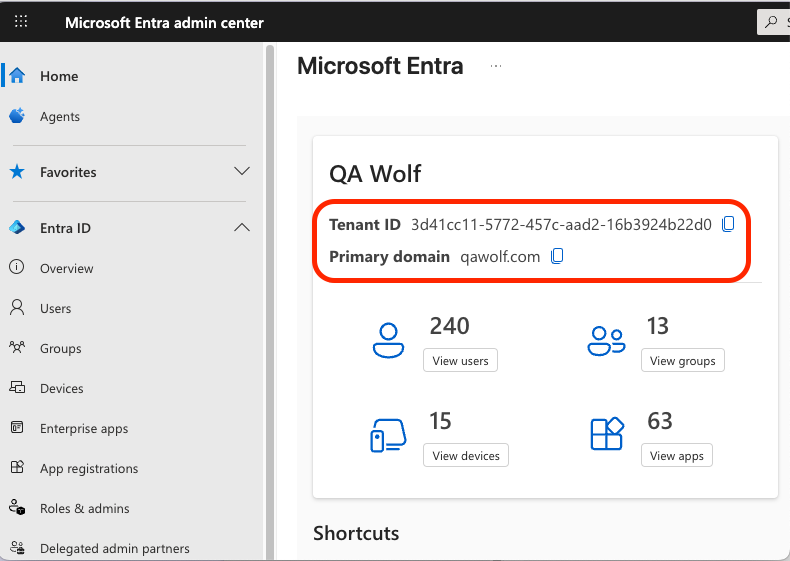
Send us your **Microsoft Entra tenant ID** and **domain name** so we can configure our side. Both are on the [Microsoft Entra dashboard](https://entra.microsoft.com/#home).
QA Wolf's tenant ID is `3d41cc11-5772-457c-aad2-16b3924b22d0`.
 ## Before you start
Shared channels depend on guest sharing being on for SharePoint and Microsoft 365 Groups, even though no guest account is created. These are on by default — confirm them only if your organization has changed them.
* **Microsoft 365 Groups** — both sharing settings enabled.
* **SharePoint** — organization-level and site-level sharing allow guests, and QA Wolf's domain is not on a blocked list.
You need the **Security Administrator** role in Microsoft Entra. A Teams administrator can read cross-tenant access settings but cannot change them.
Shared channels between Commercial and GCC clouds are not supported.
## Allow your users to join external shared channels
Shared channels are enabled by default in Teams. This policy controls whether your users may take part in a channel that another organization hosts, which is what QA Wolf's channel is.
In the [Teams admin center](https://admin.teams.microsoft.com/), expand **Teams** and select **Teams policies**. In the new admin center experience, go to **Settings & policies → Custom Policies for users and groups → Teams**.
Select the policy assigned to the people who will use the channel, then select **Edit**.
Turn **Join external shared channels** on, then select **Apply**.
## Before you start
Shared channels depend on guest sharing being on for SharePoint and Microsoft 365 Groups, even though no guest account is created. These are on by default — confirm them only if your organization has changed them.
* **Microsoft 365 Groups** — both sharing settings enabled.
* **SharePoint** — organization-level and site-level sharing allow guests, and QA Wolf's domain is not on a blocked list.
You need the **Security Administrator** role in Microsoft Entra. A Teams administrator can read cross-tenant access settings but cannot change them.
Shared channels between Commercial and GCC clouds are not supported.
## Allow your users to join external shared channels
Shared channels are enabled by default in Teams. This policy controls whether your users may take part in a channel that another organization hosts, which is what QA Wolf's channel is.
In the [Teams admin center](https://admin.teams.microsoft.com/), expand **Teams** and select **Teams policies**. In the new admin center experience, go to **Settings & policies → Custom Policies for users and groups → Teams**.
Select the policy assigned to the people who will use the channel, then select **Edit**.
Turn **Join external shared channels** on, then select **Apply**.
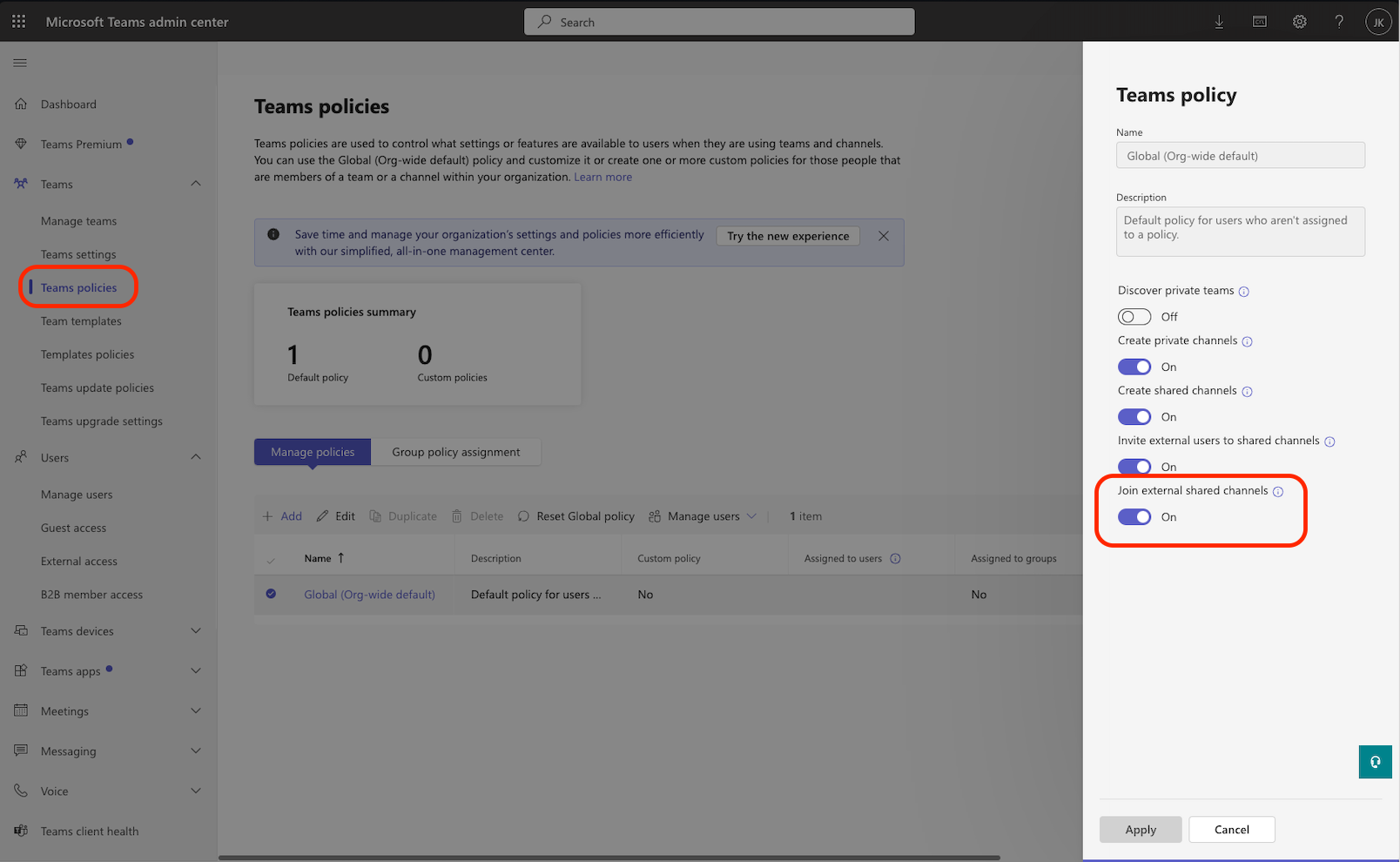 **Create shared channels** and **Invite external users to shared channels** are separate settings. Turn those on only if your team also wants to host its own shared channels and invite QA Wolf into them.
Teams policy changes can take up to 24 hours to take effect.
## Allow QA Wolf in cross-tenant access settings
B2B direct connect is blocked by default in both directions, so this step is always required. Add QA Wolf as an organization, then allow both directions: **outbound** lets your users reach our channel, and **inbound** lets our users reach yours.
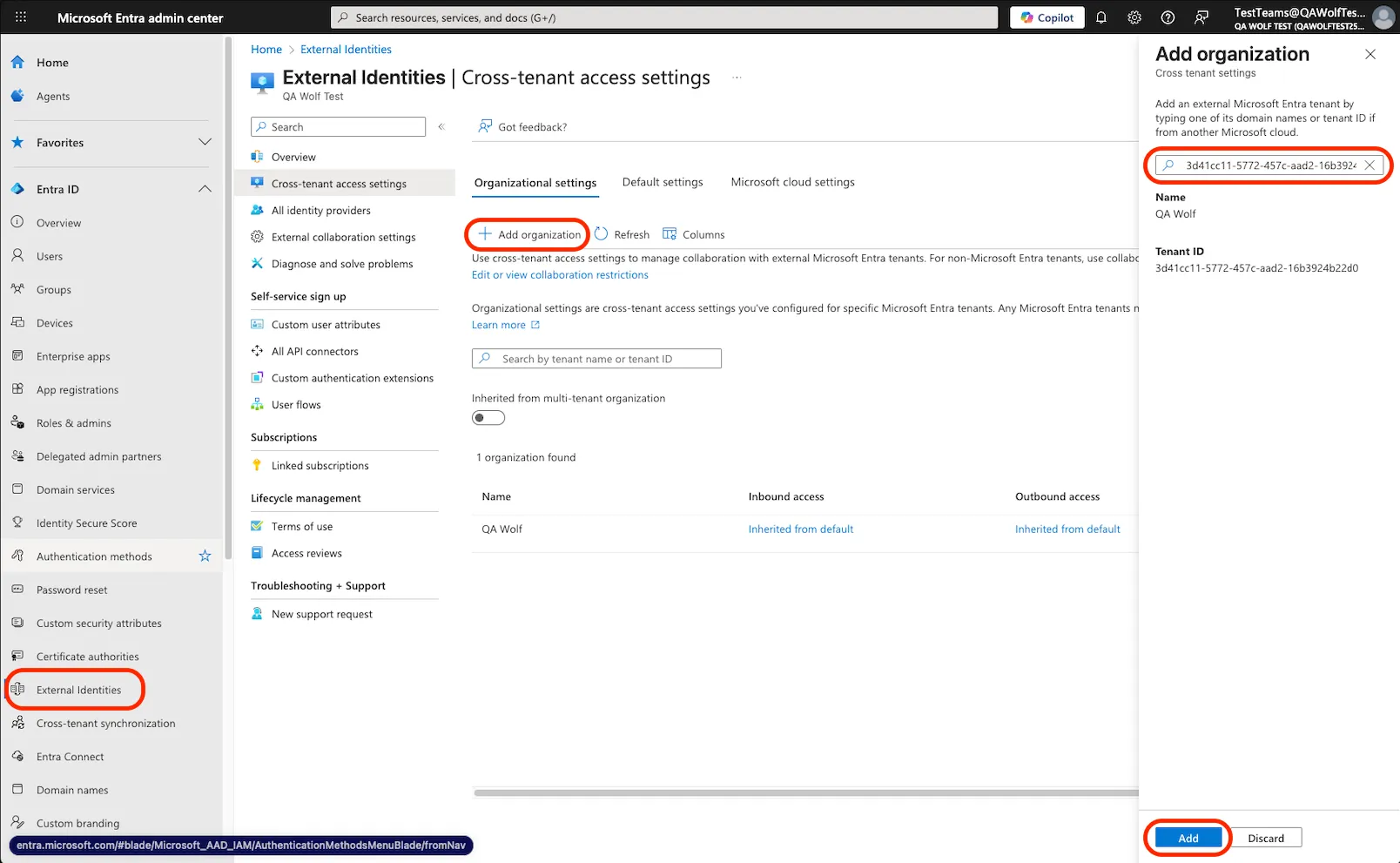
Sign in to the [Microsoft Entra admin center](https://entra.microsoft.com/) as a Security Administrator, then go to **External Identities → Cross-tenant access settings → Organizational settings**.
Select **Add organization**, enter QA Wolf's tenant ID `3d41cc11-5772-457c-aad2-16b3924b22d0`, and select **Add**. QA Wolf now appears in the organizations list, inheriting your default settings.
**Create shared channels** and **Invite external users to shared channels** are separate settings. Turn those on only if your team also wants to host its own shared channels and invite QA Wolf into them.
Teams policy changes can take up to 24 hours to take effect.
## Allow QA Wolf in cross-tenant access settings
B2B direct connect is blocked by default in both directions, so this step is always required. Add QA Wolf as an organization, then allow both directions: **outbound** lets your users reach our channel, and **inbound** lets our users reach yours.
Sign in to the [Microsoft Entra admin center](https://entra.microsoft.com/) as a Security Administrator, then go to **External Identities → Cross-tenant access settings → Organizational settings**.
Select **Add organization**, enter QA Wolf's tenant ID `3d41cc11-5772-457c-aad2-16b3924b22d0`, and select **Add**. QA Wolf now appears in the organizations list, inheriting your default settings.
 Select the link in the **Outbound access** column for QA Wolf. On the **B2B direct connect** tab, choose **Customize settings**.
* On **External users and groups**, choose **Allow access**, applied to all your users.
* On **External applications**, choose **Allow access** and **Select external applications**, then **Add Microsoft applications** and select **Office 365**.
Select **Save**.
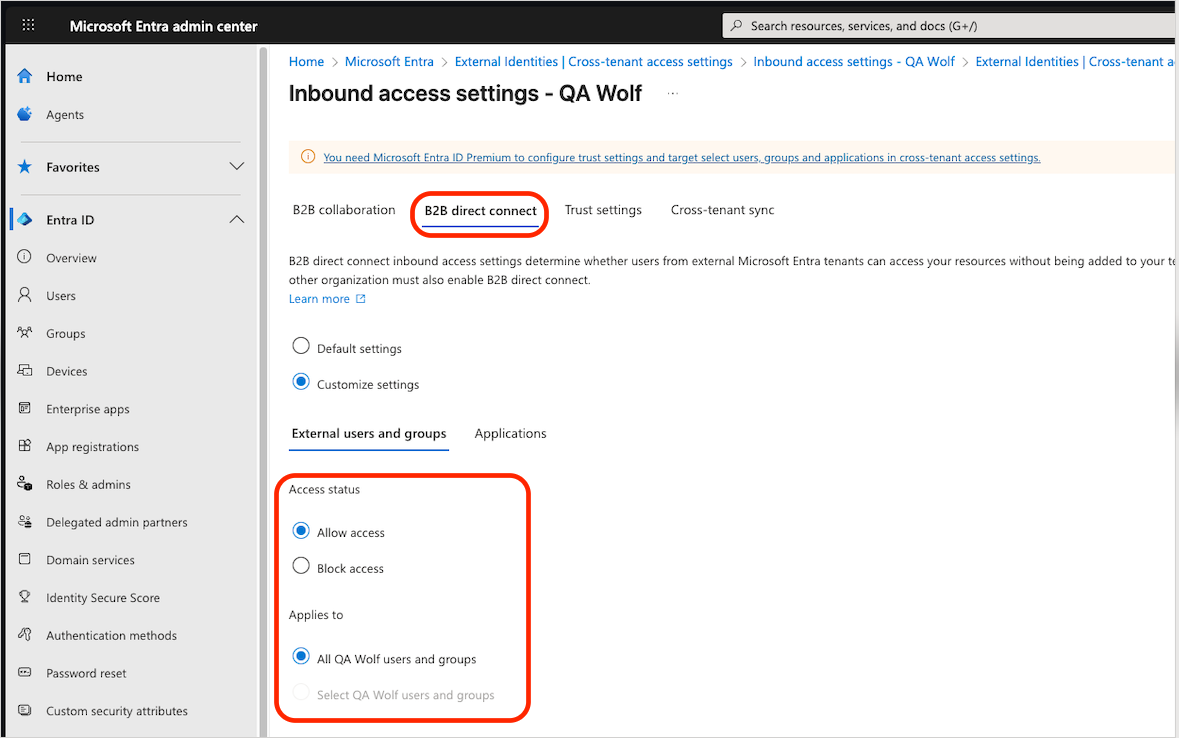
Select the link in the **Inbound access** column and repeat with **Customize settings**.
* On **External users and groups**, choose **Allow access** and **All external users and groups**.
* On **Applications**, choose **Allow access** and **Select applications**, then **Add Microsoft applications** and select **Office 365**.
Select **Save**.
Select the link in the **Outbound access** column for QA Wolf. On the **B2B direct connect** tab, choose **Customize settings**.
* On **External users and groups**, choose **Allow access**, applied to all your users.
* On **External applications**, choose **Allow access** and **Select external applications**, then **Add Microsoft applications** and select **Office 365**.
Select **Save**.
Select the link in the **Inbound access** column and repeat with **Customize settings**.
* On **External users and groups**, choose **Allow access** and **All external users and groups**.
* On **Applications**, choose **Allow access** and **Select applications**, then **Add Microsoft applications** and select **Office 365**.
Select **Save**.
 The **Office 365** application is what carries Teams and SharePoint across the connection. Allowing users and groups without it leaves the channel unreachable.
QA Wolf then appears under **organizations found**, with both directions showing as configured.
The **Office 365** application is what carries Teams and SharePoint across the connection. Allowing users and groups without it leaves the channel unreachable.
QA Wolf then appears under **organizations found**, with both directions showing as configured.
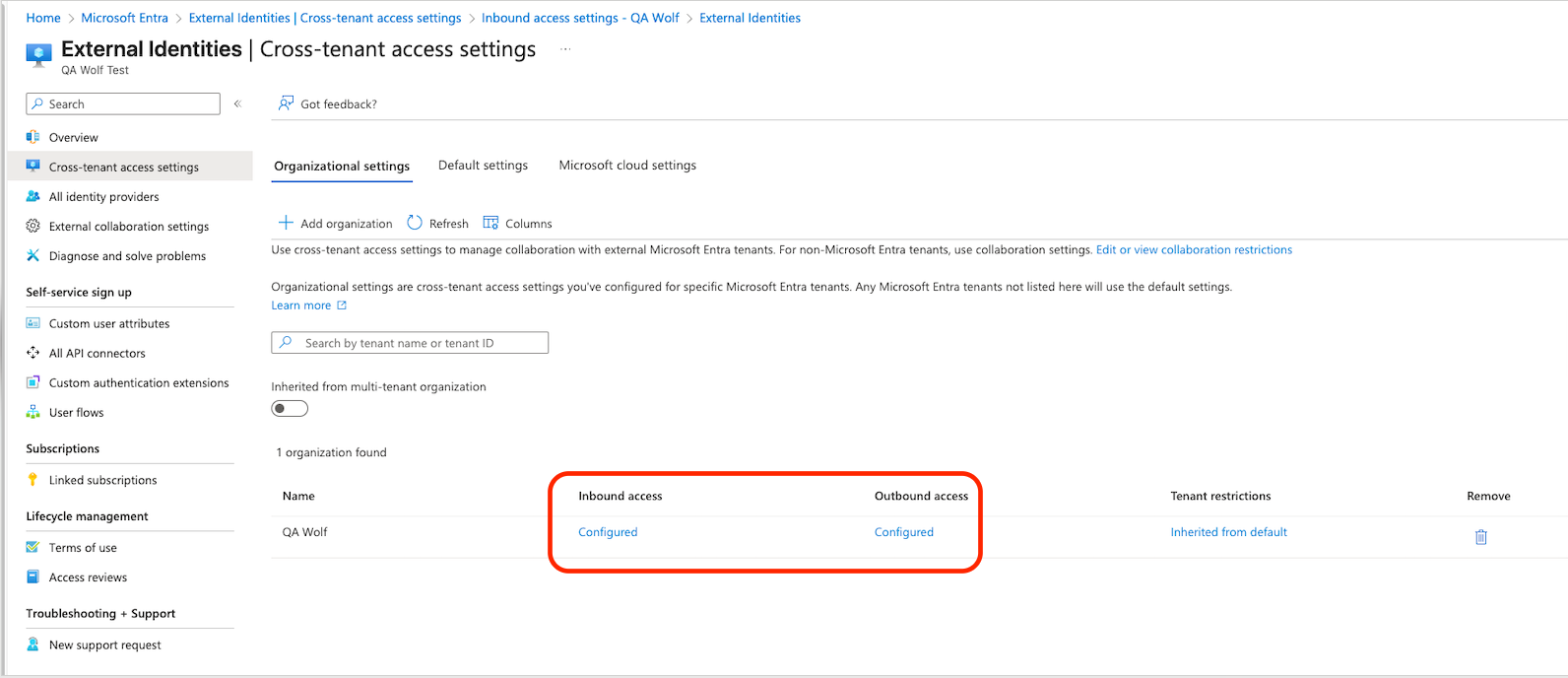 Cross-tenant access changes can take up to six hours to take effect.
## Enable external access
External access is optional. The shared channel works without it, but your team won't see QA Wolf members' presence in the channel, and QA Wolf members can't join your Teams meetings.
In the [Teams admin center](https://admin.teams.microsoft.com/), expand **Users** and select **External access**.
Under **Teams and Skype for Business users in external organizations**, make sure QA Wolf is not blocked.
Cross-tenant access changes can take up to six hours to take effect.
## Enable external access
External access is optional. The shared channel works without it, but your team won't see QA Wolf members' presence in the channel, and QA Wolf members can't join your Teams meetings.
In the [Teams admin center](https://admin.teams.microsoft.com/), expand **Users** and select **External access**.
Under **Teams and Skype for Business users in external organizations**, make sure QA Wolf is not blocked.
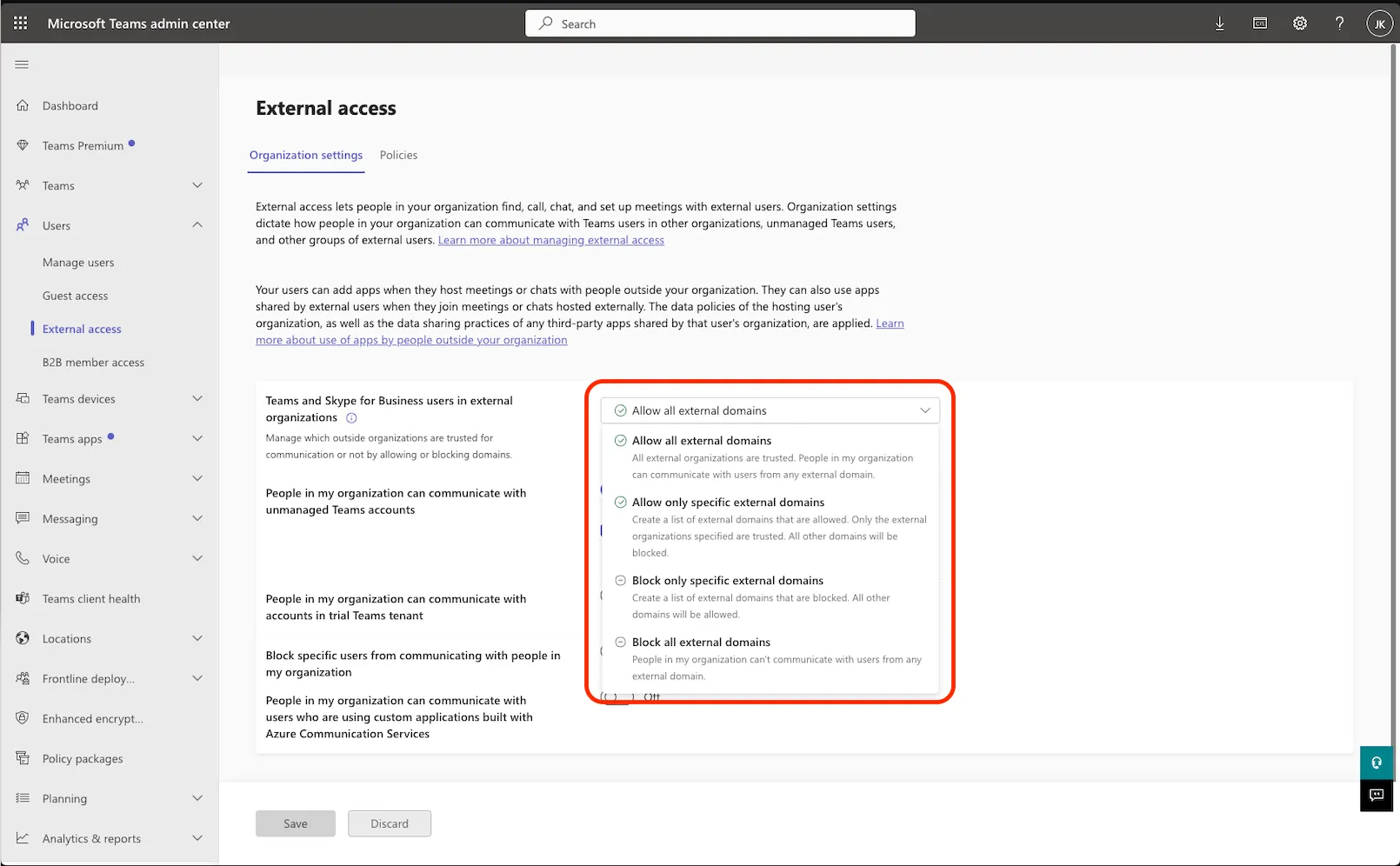 Adding **qawolf.com** under **Allow only specific external domains** keeps every other external domain blocked.
## If the channel doesn't work
* **Wait for propagation.** Cross-tenant access takes up to six hours and Teams policies up to 24 hours. Most setups that look broken immediately afterwards are not.
* **Check the Office 365 application** on both the inbound and outbound B2B direct connect settings. This is the most commonly missed step.
* **Check your default settings.** Organizational settings override defaults, so QA Wolf must be allowed on its own entry rather than relying on your tenant defaults, which block B2B direct connect.
* **Check Conditional Access.** Policies scoped to external users and the Office 365 SharePoint Online app apply to people joining a shared channel. If yours require MFA or a compliant device, set **Trust settings** on the inbound configuration to trust those claims from QA Wolf's tenant.
* **Guest accounts can't be used.** Someone who already has a guest account in your tenant has to be added by their organization account, searched as `ext:user@domain.com`.
Shared channels require **B2B direct connect**, not **B2B collaboration**. B2B collaboration creates guest accounts and requires tenant switching, and guests cannot be added to a shared channel at all. See Microsoft's [shared channels](https://learn.microsoft.com/en-us/microsoftteams/shared-channels) and [B2B direct connect](https://learn.microsoft.com/en-us/entra/external-id/cross-tenant-access-settings-b2b-direct-connect) documentation.
Adding **qawolf.com** under **Allow only specific external domains** keeps every other external domain blocked.
## If the channel doesn't work
* **Wait for propagation.** Cross-tenant access takes up to six hours and Teams policies up to 24 hours. Most setups that look broken immediately afterwards are not.
* **Check the Office 365 application** on both the inbound and outbound B2B direct connect settings. This is the most commonly missed step.
* **Check your default settings.** Organizational settings override defaults, so QA Wolf must be allowed on its own entry rather than relying on your tenant defaults, which block B2B direct connect.
* **Check Conditional Access.** Policies scoped to external users and the Office 365 SharePoint Online app apply to people joining a shared channel. If yours require MFA or a compliant device, set **Trust settings** on the inbound configuration to trust those claims from QA Wolf's tenant.
* **Guest accounts can't be used.** Someone who already has a guest account in your tenant has to be added by their organization account, searched as `ext:user@domain.com`.
Shared channels require **B2B direct connect**, not **B2B collaboration**. B2B collaboration creates guest accounts and requires tenant switching, and guests cannot be added to a shared channel at all. See Microsoft's [shared channels](https://learn.microsoft.com/en-us/microsoftteams/shared-channels) and [B2B direct connect](https://learn.microsoft.com/en-us/entra/external-id/cross-tenant-access-settings-b2b-direct-connect) documentation.